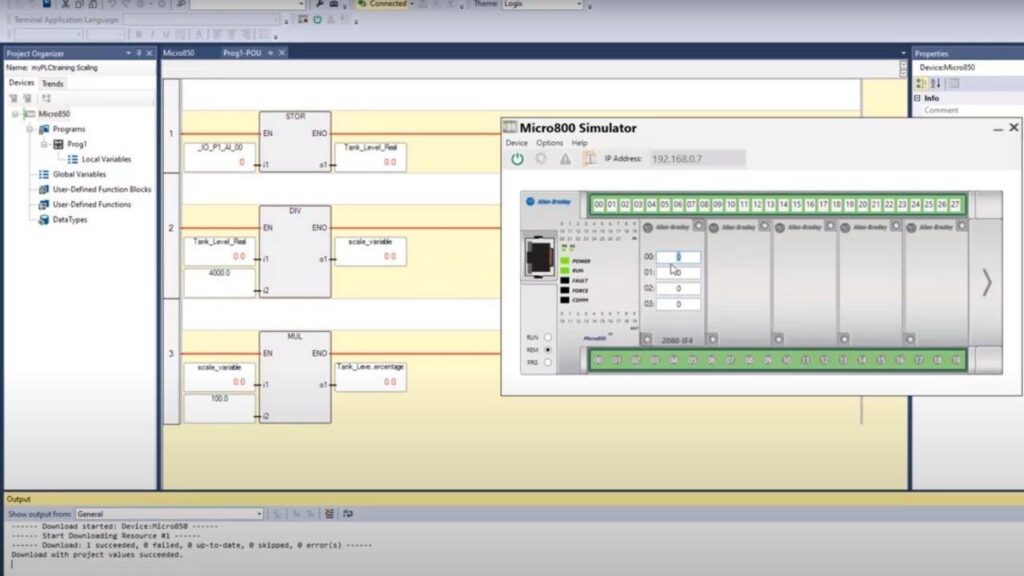
Micro800 Control Systems
Released in 2011, the combination of Micro800 micro programmable controllers and Connected Components Workbench software is ideal for machine builders and end users who need a small-footprint, modular, cost-effective solution for their small applications. Working together, these controllers and software are easy to configure, install and maintain, with many functions not found on earlier small systems, such as User-Defined Functions.
Allen-Bradley Micro800 PLC – Details
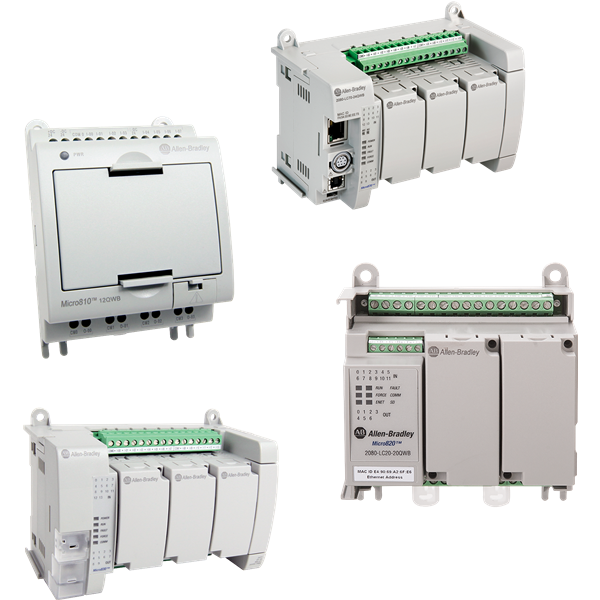
The Allen‑Bradley Micro800 PLC is part of the Rockwell Automation ‘Connected Components’ portfolio. It is designed as a low-cost, small-machine programmable logic controller (PLC) for standalone and compact automation systems, typically used by OEMs, panel builders, and small manufacturing operations.
Functionality
The Micro800 family provides compact, flexible PLC control for small and standalone machines. These controllers are specifically designed to be easy to configure, install, and maintain while keeping costs low and flexibility high. Key functionality includes:
- Programming using Connected Components Workbench (CCW) (free limited-function version available)
- Support for IEC 61131-3 programming (Ladder, Function Block, Structured Text)
- Embedded USB, serial, and Ethernet communications
- Expandable I/O and plug-in modules
- Built-in PID and closed-loop control
- Integration with HMIs, drives, and other Connected Components devices
- Simulation and testing without hardware
- Modular architecture for cost-effective machine control – just pick the modules required.
Typical Applications include:
- Pump and compressor control
- Packaging machines
- Small manufacturing equipment
- HVAC and water systems
- Standalone automation machines
- OEM equipment
Where does Micro800 site in the Allen-Bradley PLC Portfolio?
The Micro800 PLC family primarily targets and replaces the legacy MicroLogix and smart relay class controllers in Rockwell’s product range. The hierarchy in Rockwell PLC lineup is:
ControlLogix → Large plant control
CompactLogix → Machine/line control
Micro800 → Small standalone machines
Smart relays → Very basic control
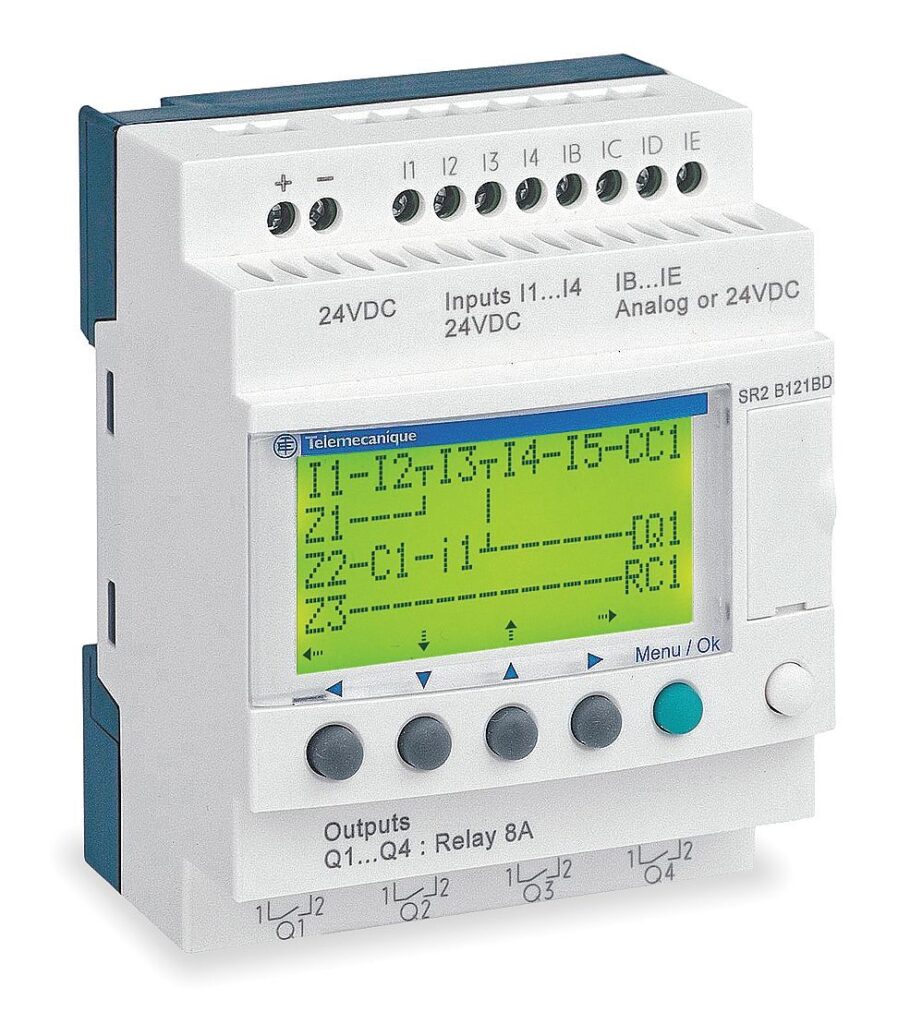
What is the difference between a PLC and a smart relay?
PLCs are designed to be versatile, allowing for easy reprogramming and reconfiguration. This makes them an excellent choice in environments where requirements evolve over time. On the other hand, smart relays are typically less flexible, cost less, and their predefined logic primarily defines their functionality. Applications for smart relays are hence limited to where the control requirements are small and simple. Functions are limited to simple boolean algebra controlling relays, timers and counters.
Micro800 Series Models
The Micro800 family includes several controller variants:
- Micro810 (nano PLC / smart relay replacement)
- Micro820 (compact Ethernet PLC)
- Micro830 (basic machine control)
- Micro850 (advanced standalone machine control)
- Micro870 (high-performance expandable controller)
These models provide increasing processing power, communication options, and I/O expansion capability. The Allen-Bradley Micro850 and Micro870 controllers feature a backplane system, while the smaller Micro810, Micro820, and Micro830 models typically use plug-in modules instead of a traditional backplane.
Latest Released Features and Enhancements
New Micro820 L20E Controllers (2025)
- USB-C connectivity
- Faster processing
- Improved communications
- Support for multiple nodes
- Better performance for compact machines
- Simplified configuration
These improvements aim to enhance processing speed, communication performance, and ease of machine development.
Connected Components Workbench (CCW) Enhancements
Recent Micro800 improvements include:
- MicroLogix legacy address mapping support
- PCCC instruction compatibility
- Simulation without hardware
- Improved commissioning tools
- Bit-level commenting and daylight-saving functions
- Integrated programming, HMI, and device configuration
- Faster machine development and onboarding. This helps engineers to modernise legacy MicroLogix systems and reduce conversion risk.
Improved Integration and Flexibility
Recent releases also emphasise:
- Expanded firmware for Micro850 and Micro870
- Easier standalone machine commissioning
- Improved installation flexibility
- Better integration with Connected Components
- Simplified system configuration
- Support for MicroLogix migration
- Cloud connectivity with MSQQ Protocol
Summary of the Micro800 Range
Stylistically, it’s not pretty – it looks like something cooked up purely for functionality. However, it is economical and the modularity provides good scalability. The new software is another tool to learn, but that’s what us engineers do – leverage our knowledge onto another platform and figure out the gaps in our knowledge through experimentation or learning.