
The Origins: The Compression Rheostat Company (1903–1909)
The foundation of what would become a global industrial giant began in 1903 in Milwaukee, Wisconsin. Lynde Bradley, a young inventor who had developed an innovative compression rheostat (a device used to control the speed of electric motors by varying electrical resistance), sought financial backing to commercialise his invention. He partnered with Dr. Stanton Allen, a prominent local orthopedic surgeon who provided the crucial initial investment of $1,000.
Together, they formed the Compression Rheostat Company. In 1904, Lynde’s younger brother, Harry Bradley, joined the business to assist with operations and manufacturing.
The company’s early product line centered on these carbon-disk compression rheostats, which were highly reliable and found a ready market in controlling electric cranes, elevators, and industrial machinery. In 1909, the business officially rebranded, combining the surnames of its primary financial backer and its core inventor to become the Allen-Bradley Company.
Expanding the Core & Driving the War Effort (1910s–1940s)
As electricity rapidly standardised across American industry, Allen-Bradley expanded its catalog beyond basic rheostats into broader electrical control equipment.
Product Diversification: The company began manufacturing automotive electrical components, switches, circuit breakers, and eventually, carbon composition resistors. These resistors became incredibly vital with the dawn of commercial radio in the 1920s and 1930s.
The World War II Boom: During the Second World War, Allen-Bradley’s production skyrocketed. Their high-quality resistors and electronic components were critical for military hardware, including radar equipment, walkie-talkies, and aerospace instrumentation. Nearly 80% of their production during the war years was dedicated to military contracts, cementing their reputation for rugged, industrial-grade reliability.
The Shift to Industrial Automation (1950s–1980s)
Following the war, the manufacturing landscape began transitioning from simple mechanised control to automated system logic. Allen-Bradley was at the forefront of this shift.
The Motor Control Era
Throughout the mid-20th century, the company became synonymous with industrial motor control. Their Bulletin 709 magnetic starters became an industry standard, famed for their reliability and modular design.
Entering the Digital Age
As solid-state electronics emerged, Allen-Bradley realized that hard-wired relay logic was giving way to computerised control.
The PLC Revolution: In the late 1960s and early 1970s, Allen-Bradley pioneered early Programmable Logic Controllers (PLCs). They played a massive role in standardising the term ‘PLC’ (which they actually trademarked for a period) and introduced the highly successful PLC-2 and PLC-5 platforms.
System Integration: They expanded into CNC (Computer Numerical Control) systems, industrial networks (like Data Highway and its successor Data Highway +), and proximity sensors, transitioning from a component manufacturer into a full-scale industrial automation solutions provider.
The Rockwell Automation Acquisition (1985–Present)
By the mid-1980s, Allen-Bradley was a dominant force in the global automation market, making it an incredibly attractive target for larger technology conglomerates looking to anchor their industrial portfolios.
The 1985 Purchase: In 1985, Rockwell International acquired the Allen-Bradley Company for a historic $1.65 billion. At the time, it was one of the largest acquisitions in Wisconsin history.
The Rebrand: Rockwell recognised the immense brand equity carried by the name. Rather than dissolving it, they leveraged Allen-Bradley as their flagship brand for industrial automation hardware and software. This insight is tyically rare in corporate America!
In 2001, Rockwell International spun off its aerospace and defense divisions, officially renaming the remaining enterprise Rockwell Automation.
Market Share v Competitors
Dominant in The Americas, and Australia, they share Asia with Siemens, but have relatively little market share in Europe. This table identifies the top 20 global markets for Industrial Automation, along with the dominant vendor in that region. Rockwell’s global market share is approximately 10% of the $256 billion market.
| Rank | Country | Primary Industrial Drivers | Leading Automation Vendor | Market Contect and Competitors |
|---|---|---|---|---|
| 1 | United States | Automotive, F&B, Aerospace, Semiconductors | Rockwell Automation | Holds a >50% share in the U.S. PLC market; Siemens is the main challenger. |
| 2 | China | Electronics, EV Batteries, Heavy Machinery | Siemens | Widely used across major lines, heavily challenged by domestic vendors like Inovance. |
| 3 | Germany | Automotive, Industrial Machinery, Chemical | Siemens | The absolute home-market stronghold via its TIA Portal ecosystem. |
| 4 | Japan | Robotics, Automotive, Precision Electronics | Mitsubishi Electric | Domestic players (Mitsubishi, OMRON, Fanuc) heavily dominate the market. |
| 5 | South Korea | Semiconductors, Electronics, Automotive | Mitsubishi Electric / Siemens | Mitsubishi leads in electronics/semis; Siemens is strong in heavy automotive. |
| 6 | India | Automotive, Pharmaceuticals, Textiles | Siemens / ABB | Highly competitive; Siemens leads factory automation, ABB leads process/power. |
| 7 | France | Aerospace, Infrastructure, Automotive | Schneider Electric | Strong home-court advantage, especially in energy management and infrastructure. |
| 8 | Italy | Packaging Machinery, Automotive, Fashion/Textiles | Siemens | Dominates machine builder (OEM) exports, with Rockwell trailing closely. |
| 9 | Mexico | Automotive Assembly, Electronics, Aerospace | Rockwell Automation | Intimately tied to the North American supply chain and U.S. manufacturing standards. |
| 10 | Canada | Natural Resources, F&B, Automotive | Rockwell Automation | Shares the same distribution network and footprint as the U.S. market. |
| 11 | United Kingdom | Aerospace, Food & Beverage, Energy | Siemens | Siemens leads factory automation, though Rockwell has a massive legacy footprint. |
| 12 | Brazil | Agriculture, Mining, Automotive | Siemens | Siemens leads in factory control, competing heavily with local motor giant WEG. |
| 13 | Taiwan | Semiconductor Foundries, Electronics | Mitsubishi Electric | Heavily relies on Japanese architecture for high-speed electronic assembly lines. |
| 14 | Spain | Automotive, Renewable Energy, F&B | Siemens | Leads the market alongside strong infrastructure positioning from Schneider Electric. |
| 15 | Saudi Arabia | Oil & Gas, Petrochemicals | Honeywell / Emerson | Process-heavy market dominated by Distributed Control Systems (DCS) giants. |
| 16 | Australia | Mining, Bulk Material Handling, Resources | Rockwell Automation | Highly dominant in heavy mining infrastructure alongside Siemens. |
| 17 | Switzerland | Pharmaceuticals, Precision Machinery, Food | ABB | Home market for ABB, which rules in robotics, motion, and process control. |
| 18 | Netherlands | Logistics/Warehousing, Agriculture, Chemical | Siemens | Dominates massive automated port logistics and process integration. |
| 19 | Singapore | Advanced Electronics, Biomedical, Logistics | Siemens / Yokogawa | A high-density robotics hub; Yokogawa dominates regional process control. |
| 20 | UAE | Infrastructure, Oil & Gas, Desalination | Honeywell / ABB | Focused heavily on process automation, building management, and smart infrastructure. |
Today, Allen-Bradley operates as the premier brand under the Rockwell Automation umbrella. Its legacy lives on in the modern factories of the world, where its PLCs, visualisation products, motor controls including variable frequency drives (VFDs) and servo drives, network switches, automation development software, safety devices and mainstays like sensors, control relays and pushbuttons remain the backbone of global industrial automation.
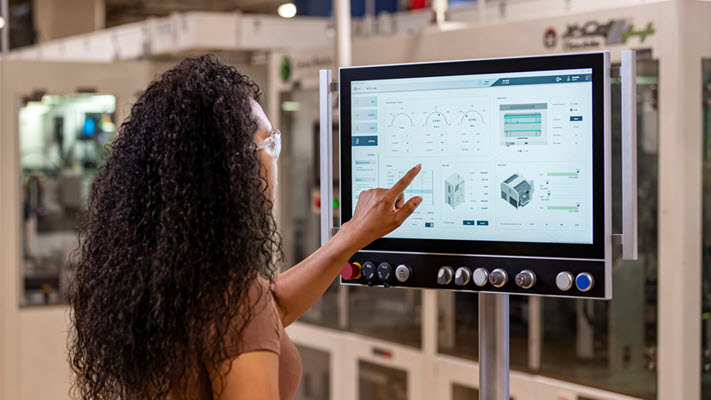
Today, Allen-Bradley operates as the premier brand under the Rockwell Automation umbrella.
Its legacy lives on in the modern factories of the world, where its PLCs, visualisation products, motor controls including variable frequency drives (VFDs) and servo drives, network switches, automation development software, safety devices and mainstays like sensors, control relays and pushbuttons remain the backbone of global industrial automation.