
Stratix Industrial Ethernet Switches
A little Industrial Ethernet History
Rockwell Automation partnered with Cisco in 2012 to release the Stratix range of industrial ethernet switches. This replaced a long-standing relationship between Rockwell and Hirschmann, a German manufacturer of true industrial ethernet switches that had been developed from the ground up for use by engineers, not IT wonks!
Belden had earlier acquired Hirschmann from European private equity company HgCapital in 2007. This may have precipitated the change in direction from Rockwell, who until then had championed the easy to use Hirschmann GUI and robust fanless design.
Interestingly, Stratix is also the name of a range of Intel FPGA (Field-Programmable Gate Array) products. It is not known how Rockwell / Cisco managed to adopt a name that was already in use in a related field without legal action!
Cisco Based Hardware
The first observation about Stratix is that is built by Cisco, well known in IT circles and beloved by IT types who spend much of their time configuring networks and who have hence mastered the text-based Command Line Interface (CLI). The Stratix GUI goes a fair way to avoiding needing to access the CLI, but it’s not, in our view, anywhere near as comprehensive nor intuitive as the Hirschmann interface. Further, it has some confusing grammatical use (confusing Selections (Enable) and Status (Enabled)) for example, which take some time to figure out.
Another criticism is that the current generation – Stratix 5200 in 2026 – takes over 2 and a half minutes to boot up – for an industrial product, that’s excessive.
See below for our full review. In summary, we are big fans of the Allen-Bradley range of controllers, but not this range of half-baked switches!
Stratix Release History
Here is a chronological record of the Stratix switches, first released in 2008.
Stratix Model 8000
These switches were the first models in the Stratix lineup, offering managed switching capabilities suitable for industrial environments. Launched in 2008, the Stratix 8000 was a modular managed switch designed for industrial applications, offering features such as DIN Rail Mounting, 24Vdc supply and fanless design
Stratix Model 8300
Introduced in 2010, the Stratix 8300 was a Layer 3 modular managed switch that provided advanced routing capabilities for industrial network
Stratix Model 5700
Announced on September 6, 2012, the Stratix 5700 was a compact Layer 2 managed switch suitable for a range of applications, from entry-level machine builders to integrated user solutions.
New Features:
- Integrated Device Level Ring (DLR) connectivity for optimized network architecture.
- Network Address Translation (NAT) capabilities for IP-address mapping from local, machine-level IP addresses to the broader plant network.
- Power-over-Ethernet (PoE) versions to enable power delivery over the same cable as Ethernet, reducing the need for separate power cabling.
- Security features such as access control lists to ensure that only authorised devices, users, and traffic can access the network.
- Optional Secure Digital (SD) card for simplified device replacement – a big advancement in our view.
- Available in six, 10, and 20 fixed-port configurations.
- Hardware features include IEEE-1588 time synchronisation, Quality of Service (QoS) prioritisation, and Resilient Ethernet Protocol. REP provides much faster response to a failed link than traditoinal commercial network functions like Rapid Spanning Tree Protocol, decreasing repair time from seconds to milliseconds.
- Software features to improve network performance, troubleshooting, and availability.
- Each base model comes with dual power inputs, input and output alarms, console port, fibre-ready SFP slots, and an operating temperature range of -40°C to 60°C.
- Model options include two gigabit ports, SD flash card, conformal coating, and two different software configurations, totaling 20 different models to best match machine and end-user applications.
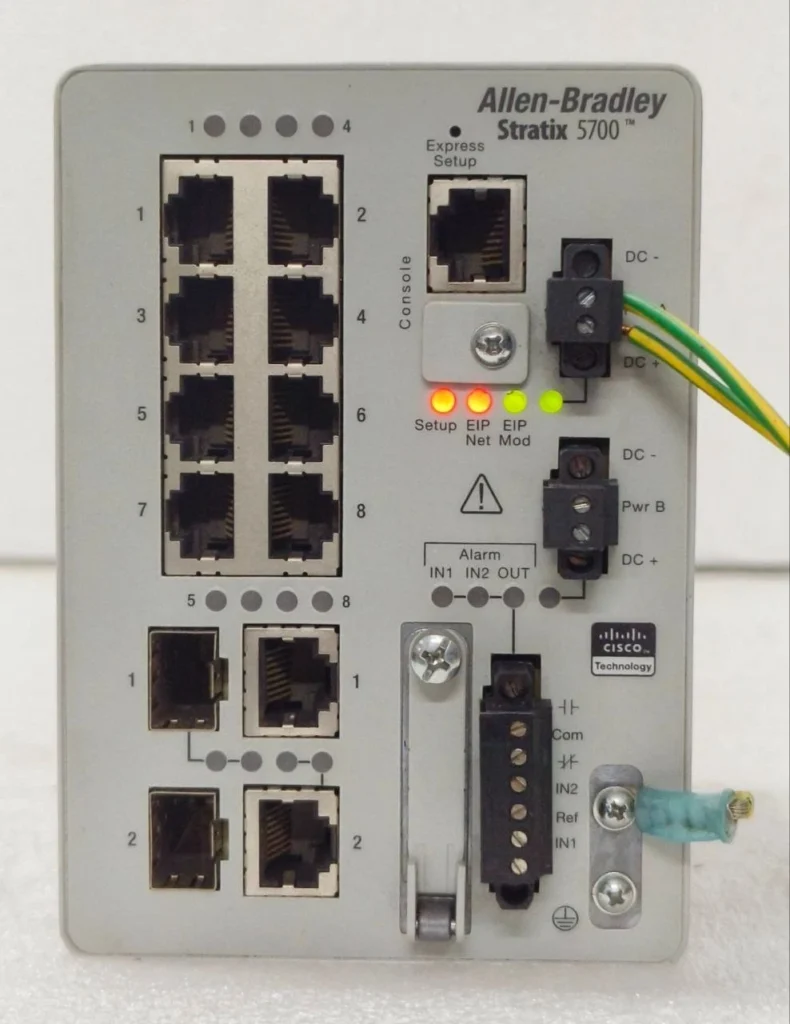
Stratix Model 5400
The Stratix 5400 (2014) introduced Gigabit managed switch capacity supporting Layer 2 switching and Layer 3 routing, with enhanced scalability and performance for industrial networks.
New Features:
- Enhanced performance and scalability for industrial applications.
- Support for both Layer 2 switching and Layer 3 routing capabilities.
- Advanced security features and improved integration with enterprise networks.
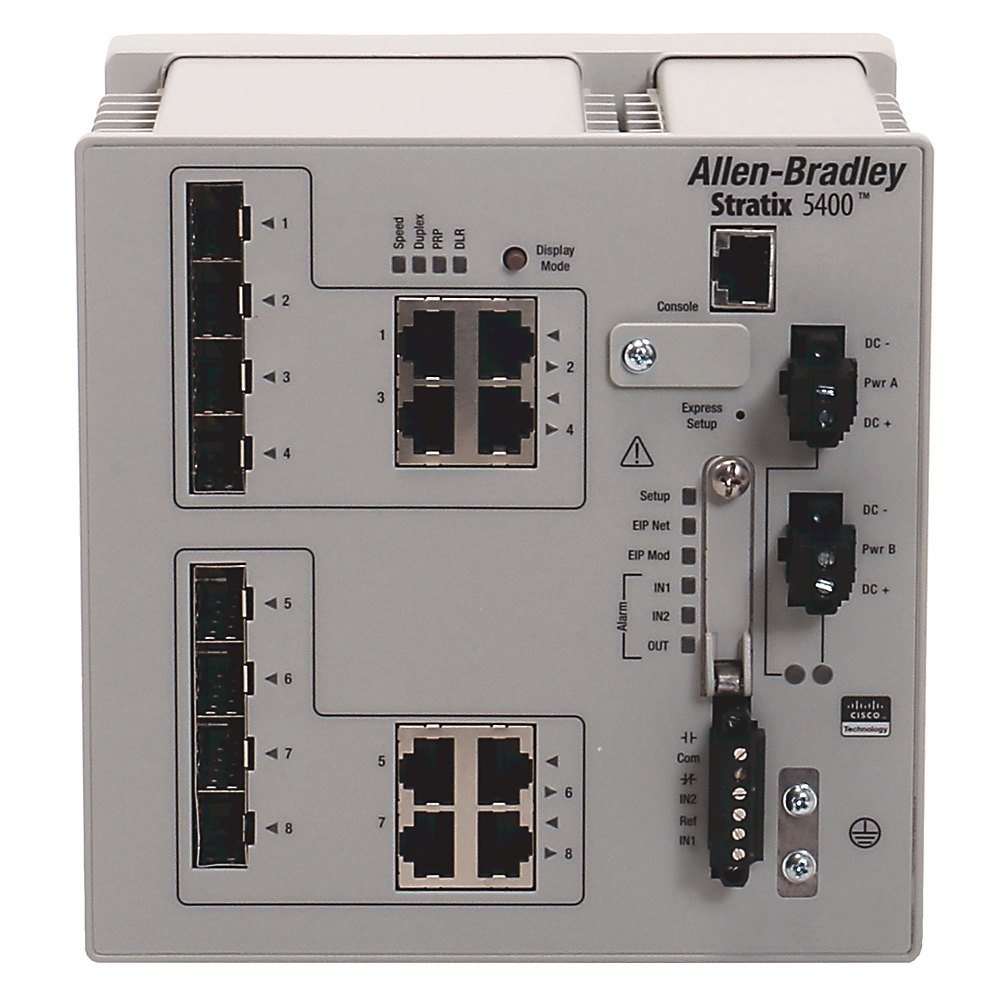
Stratix Model 5800
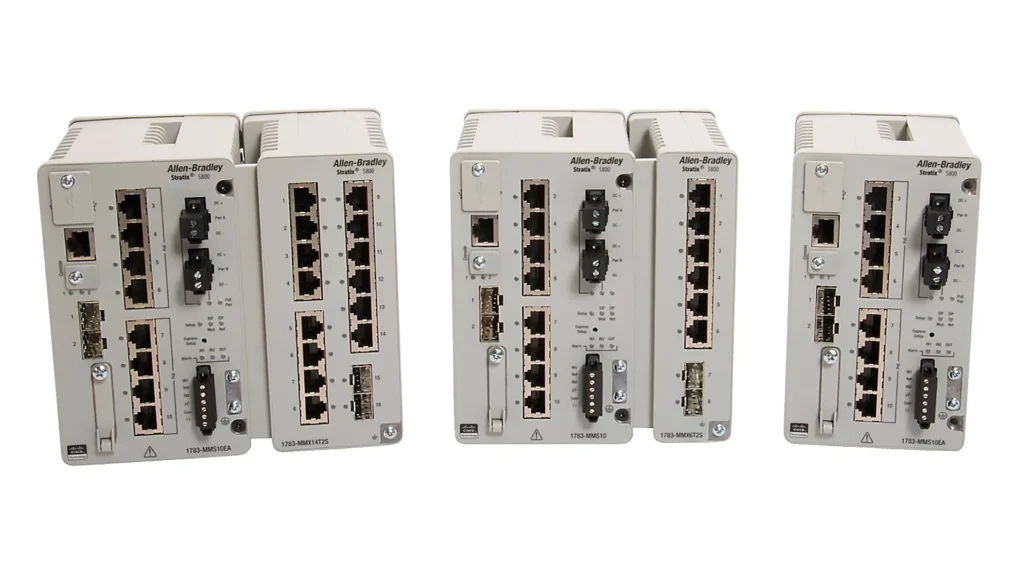
The Stratix 5800 (2019) was the first range to use the Cisco IOS-XE operating system. That comes with a new WebUI interface which included new menu structures and workflows, customisable dashboards, screen sorting and filtering, and file manager.
New Features:
- High-end modular platform designed to replace the older Stratix 8000 series.
- When used with expansion modules, it offers more ports than the Stratix 5400.
Stratix Model 5200
The Stratix 5200 is the latest addition to the Stratix series (as of 2025), a managed industrial Ethernet switch that provides flexible and adaptable solutions for a wide range of industrial applications, featuring optimised integration with Studio 5000 software through an AOP.

New Features:
- Designed to replace the Stratix 5700 series.
- Compact, scalable switches with embedded Cisco technology.
- Suitable for applications ranging from small, isolated networks to complex systems.
- Features default configurations for industrial applications to optimize performance and simplify setup, reducing costs and downtime.
- Supports both IT and OT configuration and management tools, allowing users to leverage their prior expertise during integration.
- Only available in 10 and 20 port models.
Stratix 5200 Product Review
- Time To Boot is 140 seconds, comparing very unfavourably with other units on the market. For an industrial product, this is unacceptable. It is 2 orders of magnitude slower than a PLC’s startup time. Major fail!
- In an air-conditioned room at around 20degC, the internal temperature is measured in the high 40degC range. It is difficult to imagine that these units could operate in an environment of 65degC as they claim and not be well into overheating terrritory.
- Much of the front-face labelling is in small, faint text that is impossible to read without direct lighting.
- The power supply terminals are small and require a jewellers screwdriver to connect wiring to. Forget about daisy-chaining power supply cabling unless using very small conductors without ferrules.
- Further, the ‘captive screw’ on one of our terminals fell out!
- The Negative Power Supply terminal is located above the Positive, defying normal convention of positive on top and negative on the bottom, as is common on wiring diagrams.
- The GUI is not intuitive, clearly having been governed by the Cisco team who love complexity, not Rockwell whose strength has always been the user-friendly nature of their programming tools. Try to find where to change the IP address after the initial setup. (Hint – it’s in the VLAN section!)
- What we DO like is that all connections and indicators are on the front face. There – we found something to be positive about!
- Do you want to know what your network is connected to? You would, wouldn’t you. But Stratix won’t tell you. It will identify other Stratix switches, but only by name, not IP address. It does not reveal to you anything else, without a multistage process of command line instructions to identify what MAC addresses are on each port or each switch (ignore the uplinks), then a reverse ARP enquiry or equivalent to decode the IP address. Really?
- There is no network management software from Rockwell, so you are on your own selecting products from Hirschmann (Industrial Hivision), MOXA (MXview), or ManageEngine (OpManager) for example. Hirschmann and Moxa both provide a free fully-featured time-limited demo version, though it does have limitations on network size.
- Configuration download fails on a ‘Insufficient Memory Error’ – a hard to fathom explanation when the file is a meagre 20kB! This problems may have been fixed by firmware updates, but it is not mentioned in the Rockwell documentation as a known bug.
Stratic 5200 Review Summary
In our view, the model 5200 is just not a true industrial ethernet unit, compared for example to Hirschmann (whose failure however to respond to our numerous sales enquiries cost them the opportunity to quote for our $100k project).
The 5200 gets WAY too hot, the panel labelling is extremely difficult to read, the GUI is a bit difficult to work with, and the reboot time is FAR too slow. If you can get them to respond, we’d go with Hirschmann as first choice for true Industrial Ethernet Network Switching built for engineering not IT. Stratix still feels like a Cisco product shoe-horned into an Allen-Bradley badge. Give us your thoughts below. Are we being harsh?
