
Allen-Bradley ControlLogix PLC / PAC
The ControlLogix family was introduced in 1997. Like its predecessor the PLC-5, this platform was also rack-based, but having much faster scan times and memory than the PLC-5 or SLC products. Communication modules support Ethernet, DeviceNet, DH485, and ControlNet. Of these, only Ethernet, predominately via the EtherNet/IP protocol remains as a viable choice in 2026.
Over time, the new Logix programming engine came to embrace the feature set that we now take for granted; object-oriented programming (OOP), text-based symbols, user-defined data types, customisable routines (called Add-On Instructions, or AOI). Program structures were flexible with ‘Cyclic’ and ‘Event-Driven’ tasks added to the traditional ‘Continuous’ task. Significantly, since the L7 series in firmware versions 22 and above, documentation is now stored on the CPU rather than an offline file, where it is prone to be lost or subject to version confusion.
In 2000, the little-brother CompactLogix was launched, with the intention of replacing the SLC-500 families.
ControlLogix is now termed a PAC (Programmable Automation Controller) rather than a PLC (Programmable Logic Controller) to indicate more firmly its capability in the areas of information, process control and motion. Nearly 30 years later in 2026, Allen-Bradley ControlLogix remains the pride of the fleet.
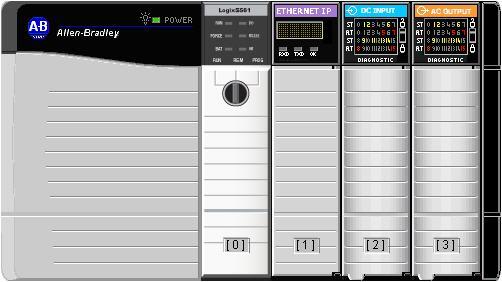
The product has been under constant development since launch, improving performance, features, memory capability, and customisation. Key features include:
- Supports 4 of the 5 IEC 61131-3 compliant languages; relay ladder logic, structured text, function block, and SFC languages – Instruction List is not supported.Add-on-instructions – custom made code blocks that look and operate just like inbuilt functions. Great for repeated devices like motors and valves.
- Structured Data. Of significant value when the project includes multiple identical objects like valves and pumps.
- Hot swappable IO modules (RIUP)
- Hugely Scalable – up to 128,000 digital; 4,000 analog across multiple chassis, networks and IO types.
- Can be used with all field IO types – Flex IO, Point IO, CompactBlock etc.
- Capability for multiple processors and network cards in-rack. This allows economical scaling of processing power.
- Support for full controller redundancy.
The ControlLogix (1756) family is considered a systems processor – capable of distributed / multi-processor control for multi-machine / plant-wide control. Yes, multiple CPUs (and comms modules) may be placed in the 1756 chassis, and in any slot – there are no longer slots reserved for processors or communication adapters.
Current ControlLogix Models
The L7, L8 and L9 families are the current models, with L6 having been discontinued in June 2017, and L5 much earlier. lFor information on program development software refer to the software page.
| Quick Comparison | |||
| Series | Family | Typical Models | Key Position |
| 5570 | L7 | L71-L75 | Legacy / being phased out |
| 5580 | L8 | L81E–L85E | Current mainstream |
| 5590 | L9 | L9xxTS variants | Latest / high-end |
ControlLogix 5570 Controllers
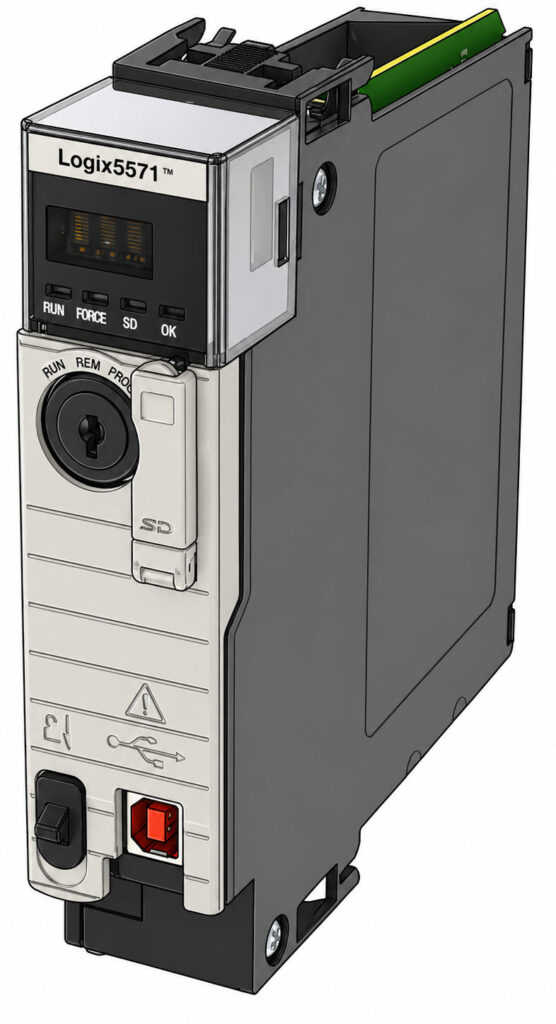
With many feature upgrades and enhanced capacity from the L6 family, they support most required functions where the L6 failed, such as compatibility with current PowerFlex interfaces for example. The firmware can also be upgraded. Hence they remain a viable option, however will of course find themselves out of support eventually.
ControlLogix 5580 Controllers
ControlLogix L8 model CPUs are now the entry level considerion for Logix engines, though keep in mind the very capable CompactLogix range. ControlLogix L8 controllers provide increased performance, capacity, productivity, and security to meet the most demanding applications.
Using the Studio 5000 program development environment allows the integration of Motion over EtherNet/IP for high-speed motion applications for up to 256 axes as well as SIL 2/PLd and SIL 3/PLe safety solutions in the safety controller range.
Some other key differentiators between the various models are shown in the following table. (Your device may need to be rotated into landscape view to see this clearly). Significant is the onboard 1Gbps network port.
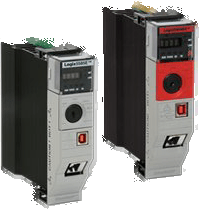
Comparison Table of ControlLogix L6, L7, L8 PAC
| Feature | L6 | L7 | L8 | L9 |
| Built-in Port | Serial | USB-B | Ethernet + USB-B | Dual Ethernet + USB-C |
| Energy Storage Module (ESM) Included | No | Yes | Yes | Yes |
| Battery Required | Yes | No | No | No |
| On-board Display Included | No | Yes | Yes | Yes |
| Non-volatile Memory | CompactFlash Card | Secure Digital Card | Secure Digital Card (optional) | Secure Digital Card (optional) |
L8 is now the go-to processor in the ControlLogix world. It’s a performance machine, for where the complexities of design or magnitude of operations can benefit from the added memory and functions, with huge IO capacity. It’s onboard 1Gbps ethernet port is also a game changer, saving the slot and expense of a comms module, or providing one for a dedicated IO network.
ControlLogix Specification Comparison
| Model | L7 | L8 | L9 |
|---|---|---|---|
| Max User Memory | Up to 32 MB | Up to 40 MB | Up to 802 MB |
| Max I/O (typical system capacity) | 128k digital (system dependent) | ~128k digital / 4k analog (typical published limits) | Similar or higher than L8 (expanded node capacity) |
| Max EtherNet/IP Nodes | ~128–250 (depends on comm modules) | Up to ~300 | Up to ~600 |
| Max Motion Axes | ~100 axes (typical upper range) | Up to 256 axes | Up to 512 axes |
| Processing Performance | Baseline (single-core era) | 5×–20× faster than L7 | ~2× faster than L8 |
| CPU Architecture | Single-core | Multi-core (dual/quad class) | Enhanced multi-core |
| Scan Time (relative) | 1× (baseline) | ~0.2× to 0.05× vs L7 | ~0.5× vs L8 |
| Integrated Ethernet | No (external module required such as 1756-EN2T) | Yes (1 Gb) | Yes (dual 1 Gb) |
Firmware Management
One needs to take into account firmware compatibility and even using the correct tools for upgrading firmware based on the version in use. There are many fundamental rules that we will seek to document here over time. Further, the version of Windows also limits software choices – Windows 7 for example is now becoming unsupported for some applications.
As a start, here are some of the rules.
- Firmware V21 and above require Studio 5000 software for programming.
- Similarly, firmware Revision 21 is the key milestone where ControlLogix controllers first gained the ability to store rung comments, tag descriptions, and documentation onboard the CPU. This was a major step forward, eliminating the need to always be working from a master version of the software to be able to enter and retain program documentation. This occurred in 2014.
- L6x ControlLogix and L32/L35 CompactLogix stopped at v20 firmware. This presents them with a number of limitations in terms of documentation and compatibility with other devices.
- There must be compatibility between a controller’s firmware and the version of the program development application. So a Version 30 Controller for example requires Studio 5000 Version 30 to be installed.
- RSStudio needs an individual version installed for each version of hardware you have. So it makes sense to pick a version, bring all your controllers to that version, then you can access them all with the one version of Studio 5000. Otherwise, you will be taking the time to download and install multiple versions.
- ControlFlash Plus is the current tool for flashing firmware. From what we can tell, it totally replaces ControlFlash and is available for free from the Rockwell Download centre.
- A new Logix controller out of the box has Version 1.4 firmware. The desired firmware version needs to be installed before it can be used.
Energy Storage Modules (ESM)
Energy Storage Modules (ESMs) are rechargeable devices used in ControlLogix systems to store system energy temporarily. They act as a backup power source to protect the controller’s memory in the event of a power loss. ESMs ensure that data is retained, and critical processes can either continue to run or shut down gracefully without data corruption.
Key functions of ESMs in ControlLogix systems include:
- Memory Retention: ESMs provide power to maintain volatile memory, so that the controller can retain important data during short-term power outages.
- Controlled Shutdown: In case of prolonged power loss, the ESM allows the controller to be able to perform a safe, controlled shutdown, reducing the risk of data corruption or incomplete operations.
- Restart Support: When power is restored, ESMs help the controller restart correctly, preventing errors during recovery.
Key Features of ControlLogix Energy Storage Modules
Currently supported ControlLogix controllers, (1756-L7x, L8x and L9x models) support the use of ESMs to manage energy and maintain system reliability. Here are the key features of ESMs:
- Rechargeable Battery-Free Design: Unlike traditional uninterruptible power supplies (UPS), ESMs do not rely on batteries. Instead, they use capacitor-based technology, which allows for longer lifespan and minimal maintenance.
- Plug-and-Play Installation: ESMs are modular and can be easily installed or replaced without needing to power down the system, minimizing operational interruptions.
- Automatic Recharging: Once normal power is restored, the ESM automatically recharges, preparing the system for any future power disruptions.
- Flexible Power Backup: ESMs provide different levels of power backup depending on the controller model and its application. Some modules provide enough power for safe shutdown, while others ensure continuous operation for a limited time.